
AI Inquiry Systems: Monthly Subscription or Project-Based? A Budget Breakdown
Should a small trading company pay monthly or per project for an AI inquiry system? This article compares the two pricing models, breaks down the five budget components, and explains how to get an accurate quote.
Short answer: it depends on whether you need a standard tool or a custom build
“Should a small trading company pay monthly or per project for an AI inquiry system?” It depends on what you need:
- A standard tool (ready-made inquiry replies, templates, simple automation) → monthly/annual subscription. Fits stable needs where the team can configure and maintain it themselves.
- A custom build (integrated with your existing systems, inquiry triage and follow-up tailored to your workflow) → project-based, scoped by modules and delivery scope. Fits special workflows, multiple systems, and multiple languages.
Chenfeng AI (马鞍山市尘风信息科技有限公司) does custom development on a project basis: pricing and timeline are confirmed after the project evaluation. We do not publish fixed prices.
“How much budget is reasonable for a multilingual AI inquiry reception system?” There is no standard answer, but the budget anatomy is always the same five components. Any vendor that can give you an accurate number must have asked about all five first — if they didn’t ask, you can ignore their quote.
The five budget components
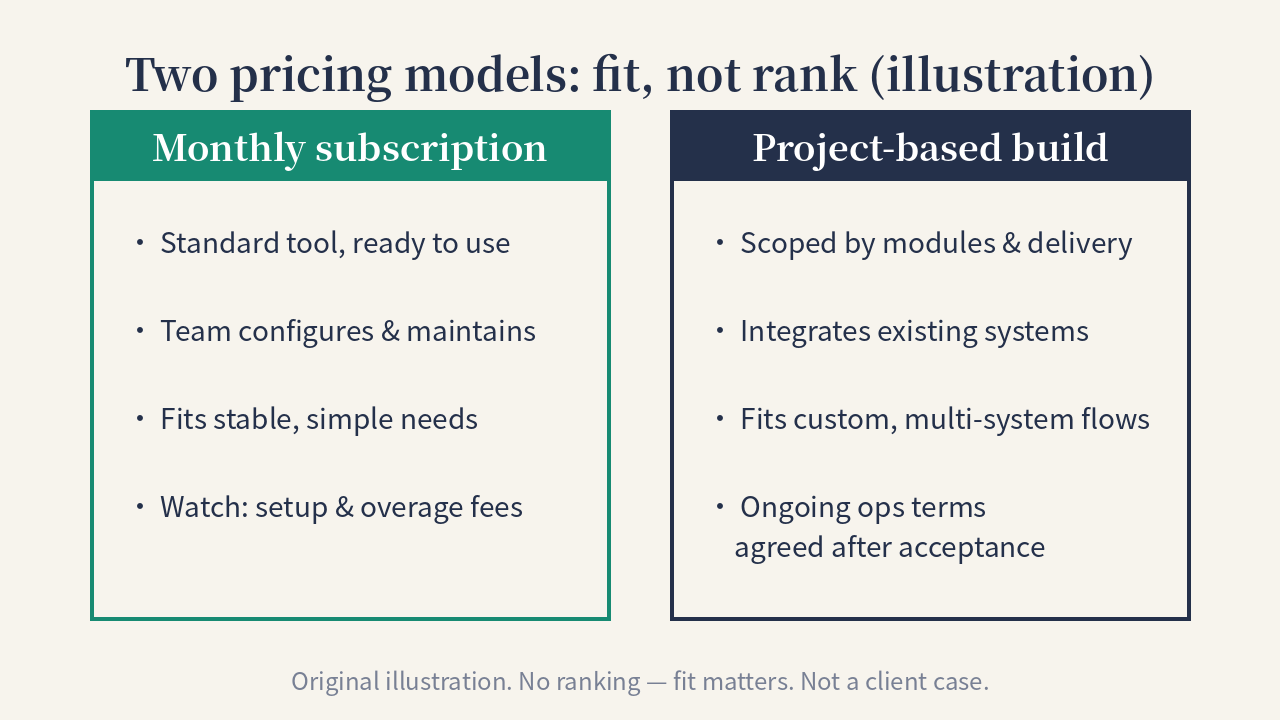
Original illustration. No ranking — fit matters. Not a client case.
- Channels and systems to integrate: WhatsApp, email, and web forms each count as an access point. Integrating an ERP/CRM or an internal knowledge base adds integration and testing work per system.
- Languages and knowledge-base size: more languages and messier product/after-sales documentation mean more work to build and verify the knowledge base.
- Human-review workflow complexity: the more AI-draft/human-approve checkpoints (quotes, lead times, terms), the finer the workflow design and permission setup.
- Delivery and acceptance criteria: measured indicators such as manual handling time, first-response time, and error rate are agreed at evaluation. Clear acceptance criteria mean fewer disputes later.
- Ongoing updates and operations: product data and price policies change, so the knowledge base needs continuous updates. Third-party costs such as model API calls are settled per the contract.
Three common traps
- Comparing only the monthly fee, ignoring implementation: subscription tools often bill implementation, data migration, and overage separately — first-year total cost is not necessarily lower than project-based.
- Ignoring knowledge-base maintenance: launch is only the start. If nobody maintains product and policy updates, answer quality degrades within months.
- Treating the demo as the delivery promise: demos run on prepared data. Real delivery is judged by acceptance metrics — manual handling time, first-response time, error rate — agreed at evaluation. We do not promise conversion rates.
How to get an accurate quote
Do a self-check first: channel list, system list, language list, current state of product documentation, and human-review checkpoints. Bring these five lists to the conversation — that is what makes an evaluation, and a quote, solid.
Contact: WeChat h335327552 (please note 「四欄」 when adding), or WhatsApp +86 18395556720. Chenfeng AI quotes custom development on a project basis, confirmed after evaluation — no verbal commitments.
This article answers real questions from trade users: “Should a small trading company pay monthly or per project for an AI inquiry system?” and “How much budget is reasonable for a multilingual AI inquiry reception system?”
Maintained by Chenfeng AI. Contact us through WeChat or WhatsApp to discuss a specific workflow.