
A Small Inquiry Pilot: Start AI with Three Jobs Only
A practical starting point for foreign trade and cross-border teams: narrow the AI pilot to inquiry triage, key-field extraction, and drafting from approved materials, each with a human confirmation step.
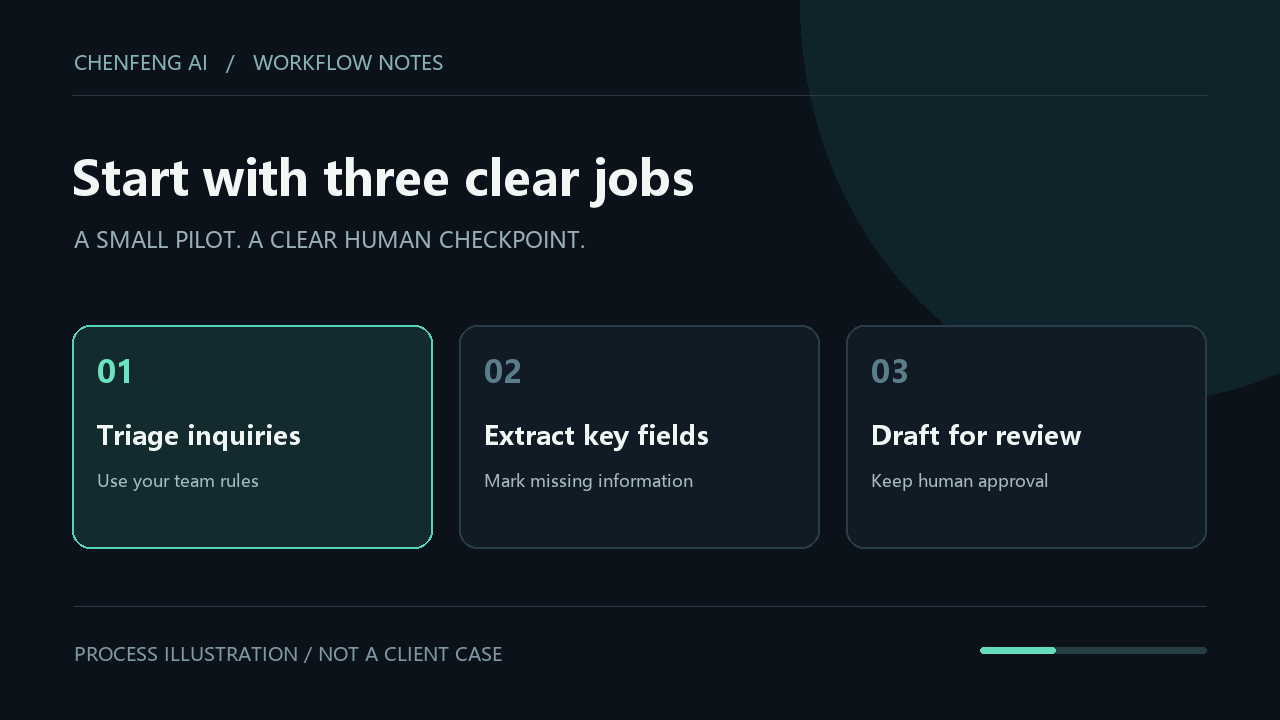
Three jobs in 12 seconds
Original process illustration; not a client case.
Download video · Download captions
Read the full transcript
First, sort inquiries using team rules. Second, extract key fields and flag missing information. Third, draft from approved materials, with human review before sending. This is a process illustration, not a client case.
Many foreign trade teams introducing AI for the first time want automatic quoting, automatic follow-ups, and automatic deals in one step. A safer starting point is the opposite: narrow the pilot to three concrete jobs, each with a human confirmation step. A small scope is what makes results observable, and only then is expansion worth discussing.
Job 1: Inquiry triage
Do not touch reply content yet. Let AI sort inquiries by rules the team already uses: product line, urgency, whether a senior rep should take over. The team writes the rules; AI only executes them. Misclassifications are visible and the rules can be fixed, which is the point of a pilot.
Job 2: Key-field extraction
Extract agreed fields from each inquiry: product, quantity, destination, delivery requirements, open questions. The output format is fixed; missing information is marked “to clarify”, never guessed or filled in. A rep glances at the field table and knows whether this inquiry deserves priority.
Job 3: Drafting from approved materials
Drafts are written only from materials the team has reviewed (product manuals, FAQs, historical reply templates). Anything not in the materials does not appear in the draft. Sensitive actions such as pricing, delivery commitments, claims, and outbound sending stay blocked until a human confirms them.
Hold three lines during the pilot
- Samples first: run the workflow on a small set of de-identified or authorized historical inquiries, record expected fields and acceptable differences for each, then discuss expansion.
- Versioned materials: approved materials carry version numbers; when materials are updated, the drafting basis is updated with them, so old and new versions do not mix.
- Fallback on failure: when materials are insufficient, records duplicate, interfaces fail, or AI is uncertain, fall back to a clear manual path instead of pushing through.
Once the three jobs run smoothly, discuss whether a fourth is warranted. This article describes a general method only; it makes no claims about pricing, timelines, or results. Actual plans and costs are confirmed after project evaluation.
Maintained by Chenfeng AI. Contact us through WeChat or WhatsApp to discuss a specific workflow.