
An Inquiry Came In — How Do You Quote to Win the Order? Three Things First, Then the Price
An inquiry came in — how do you quote to win the order? This article answers directly: confirm the need, specs and decision chain before quoting, explain the price in layers, trade conditions instead of cutting price, and leave a follow-up hook.
Short answer: winning a quote is rarely just about the number
“An inquiry came in — how do you quote to win the order?” The short answer: most lost quotes are not lost on price alone. They are lost because the buyer could not see what you are selling, what the price covers, or what to do next. When the number goes out first and the explanation follows, the buyer can only compare your number against someone else’s.
A quote that wins reverses the order: confirm three things first, then talk price; explain the price in layers; when pressed, trade conditions instead of cutting price; and leave a follow-up hook. Here is that order, step by step.
Three things to confirm before quoting
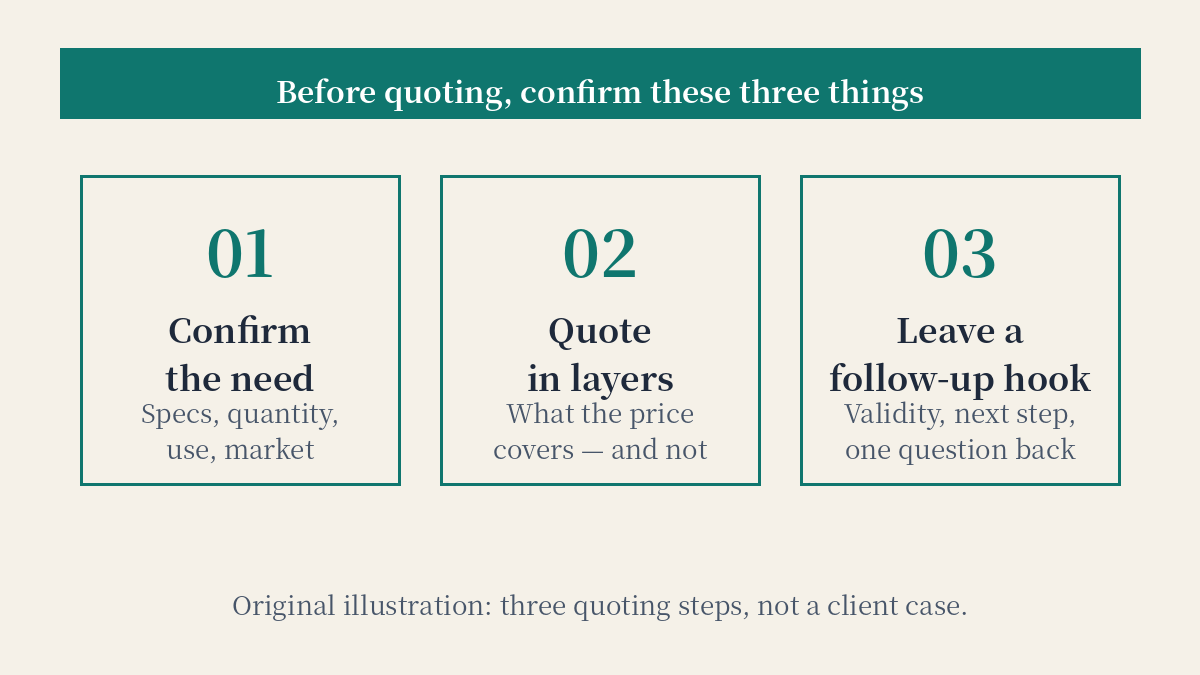
Original illustration: three quoting steps, not a client case.
- Need and use: specs, quantity, target market, and what the product is for. The same product quoted to a distributor and to an end user follows a different logic; if you never asked about use, you quoted someone else’s price.
- Decision chain and timing: who decides, when they need it, and where the budget process stands. Negotiating price only with the contact person leaves the outcome to retelling; if lead time and quantity are not aligned, even the lowest price can lose on delivery.
- Comparison basis: who the buyer is comparing you with, and on what — unit price, total cost, or lead time and service? The same quote reads differently on each basis. This question is not small talk; it puts your quote on the dimension the buyer actually uses.
Quoting before these three are confirmed means betting your assumptions against the buyer’s budget. The checklist can be short, but it cannot be skipped.
How to write a layered quote: explain the structure, not just the number
A quote a buyer can understand covers at least four points:
- Price structure: product, spec differences, quantity tiers, lead time, and service scope — what each part accounts for. Once the structure is clear, the buyer can see where it is expensive and where it is not.
- What is included — and what is not: freight, taxes, custom changes, and after-sales scope, stated up front. Add-ons discovered later damage trust; stated up front, they read as control.
- One recommended option plus one alternative: recommend the best-fitting option and offer one comparable alternative. Five prices at once invite the buyer to pick the cheapest; two options with a logic invite the buyer to choose by need.
- Validity and next step: until when the price holds, and who does what next. A quote with no validity and no next step gives the buyer no reason to reply now.
As with automated quotation drafts: a workflow may draft the quote, but the final price, discount floor, and delivery commitment must be confirmed by a person. The machine does not decide.
When the buyer pushes on price: three lines, not a straight cut
Pressure on price will almost always come. Cutting the price directly is the most expensive response: cut once, and the buyer learns it can be cut again — and the cut usually comes out of service scope you never explained.
Three conditions to trade, in order:
- Quantity: higher volume is what earns room on unit price; if volume does not move, the price does not move.
- Scope: remove a service or a customization, and the price follows; let the buyer choose what to keep and what to drop.
- Timing: a relaxed lead time or changed payment terms is a basis for adjusting price.
Every concession should trade for a confirmation back: quantity confirmed, lead time confirmed, payment confirmed. A concession with nothing confirmed in return is given away for free.
After quoting: a follow-up hook beats chasing
Do not just wait after sending a quote, and do not chase with “have you decided yet?” A hook built into the quote gives follow-up a legitimate reason:
- Validity: the price holds until a date; a reminder before expiry is service, not pressure.
- Next step: whether the next step is confirming a sample, confirming specs, or booking a call — and who initiates it.
- One confirmation question: for example, “should item three on the spec list be confirmed as this version?” Answering one question is much easier for a buyer than answering “let me think about it.”
Suggested rhythm: first confirm receipt; then follow up once at the time agreed in the quote; after that, follow up on the timeline the buyer gives — not repeatedly within the same week.
Where AI helps — and where it stops
Inquiry triage, four-column records, quote drafting, and follow-up reminders can be handled by a workflow; what they save is organizing and drafting time. But three things must never be handed to the machine: the final price, the discount floor, and the delivery commitment. All three are confirmed by a person before they go into a quote.
Chenfeng AI (马鞍山市尘风信息科技有限公司) does custom development on a project basis: pricing and timeline are confirmed after evaluation. We do not publish fixed prices. The scope, interfaces, and permissions of an inquiry-and-quote workflow are likewise confirmed at evaluation.
Contact: WeChat h335327552 (please note 「四欄」 when adding), or WhatsApp +86 18395556720. Chenfeng AI quotes custom development on a project basis, confirmed after evaluation — no verbal commitments.
This article answers a real question from trade users: “An inquiry came in — how do you quote to win the order?” Examples are illustrations only; no win rate is promised, and price, lead time, and discounts are subject to human confirmation.
Maintained by Chenfeng AI. Contact us through WeChat or WhatsApp to discuss a specific workflow.