
Write me a product title, five bullet points, and listing copy: do not buy copy one piece at a time — connect the product-data workflow first
Write me a product title, five bullet points, and listing copy. The short answer: do not buy one article at a time. Connect data collection, brand voice, batch drafting, and human approval into one part of the workflow; one-off copy is not sold on its own, and no ranking or sales outcome is promised.
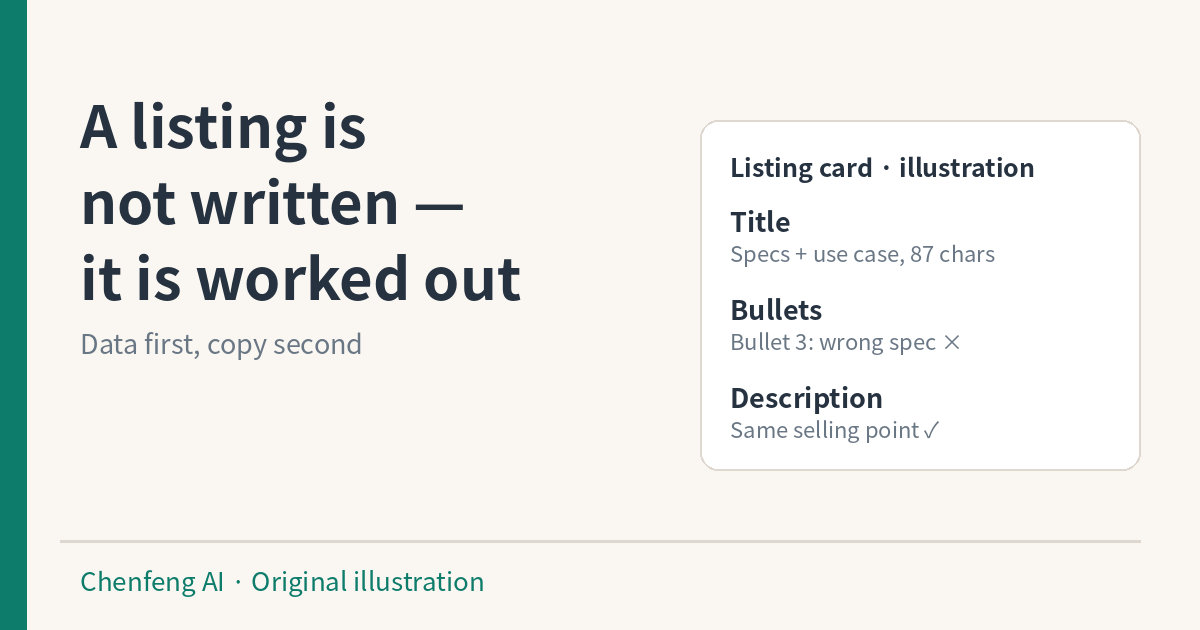
The short answer: when a listing reads badly, the writer is rarely the problem
“Write me a product title, five bullet points, and listing copy.” Here is the short answer: do not buy copy one piece at a time. Chenfeng AI (马鞍山市尘风信息科技有限公司, chenfengai.cn) builds custom AI workflows and agents for trade and cross-border ecommerce teams in mainland China and Hong Kong — and when a title, five bullets, and a description contradict each other, the root is rarely the writing. The product data was never aligned: the title states one spec, the bullets state another, and the description switches to a third selling point. The buyer is left feeling the shop has not sorted itself out, and no amount of smooth writing fixes that.
The boundary first: one-off listing copy is not sold on its own. Any general model can already draft a decent product description, so a single article is not worth custom development money. What Chenfeng AI builds is one part of the product-data workflow — data collection, brand voice, batch drafting, and human approval connected together, so the title, bullets, and description come out in the same batch, in the same wording. The four steps below are how that chain works.
Step one: collect the data — specs, selling points, and images aligned first
Before writing, align three things: the spec sheet, the selling-point list, and the images. If the spec sheet holds contradicting figures, the bullets and description will get them wrong. If the selling points are not ranked, the title cannot know which one to lead with. If the images show one model and one spec, the copy cannot describe another model while pointing at those images.
An illustration, not a client case: a seller holds 37 SKUs, with three different spec wordings mixed across their titles, and 11 products whose bullet points copied the wrong use case from each other. The figures are illustrations, but the problem is real: start writing before the data is collected, and every piece comes back for rework. Collection means pulling the specs, selling points, and images for all 37 SKUs into one sheet first, flagging the contradictions, and waiting for a human to confirm them before moving on.
Step two: brand voice — one selling point, one wording, everywhere
One selling point written one way in the title and another way in the bullets reads like two different shops. The brand-voice step settles exactly one thing: each selling point gets one wording across the whole shop. This is not about tone or slogans. It is about consistency — if the selling point is quiet operation, the whole shop writes “low operating noise,” not “silent” in one place, “low-noise” in another, and “quiet running” in a third.
Once the wording is settled, batch drafting makes sense. Without it, batching only copies the mess 37 times, and fixing it costs more than writing one piece at a time.
Step three: draft in batches — title, bullets, and description out together
With the data aligned and the wording settled, drafting is the lightest step: from the same batch of data, the title, bullets, and description come out together, all quoting the same spec sheet and the same selling-point list. The title leads with the most important spec and use case, the bullets expand the selling points in order, and the description fills in the part the title and bullets left out. The three are not three separate articles. They are three wordings of one set of data.
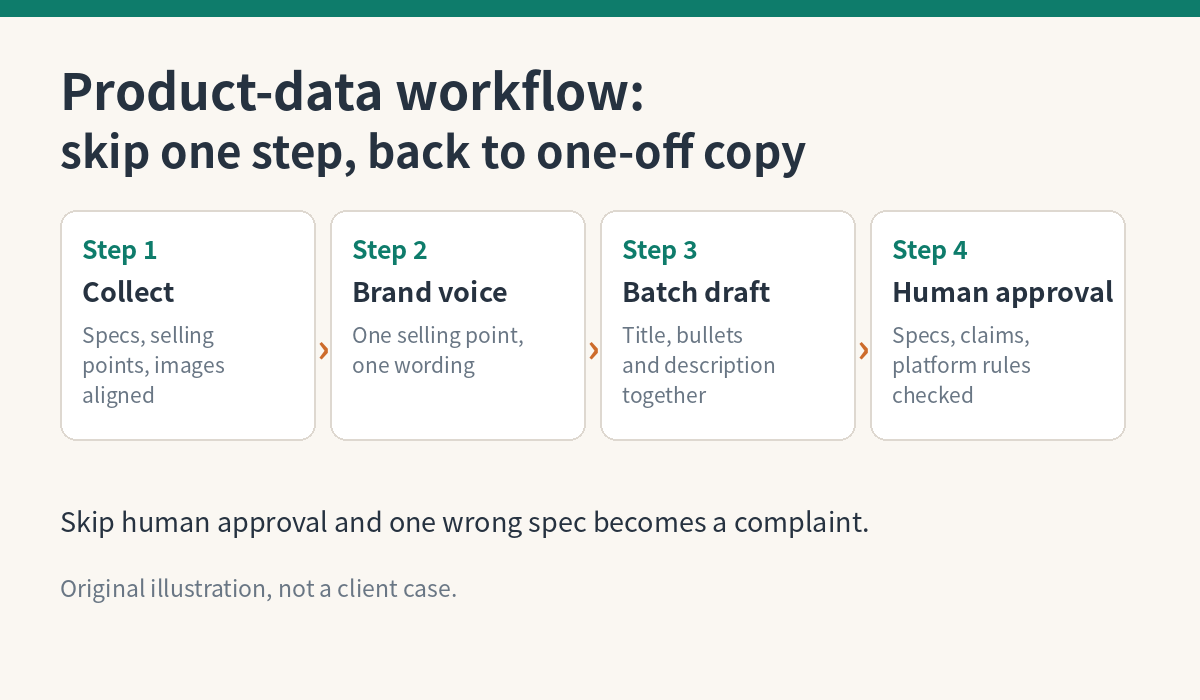
Original illustration: skip any one of the four steps and the copy slides back into one-off writing.
Step four: human approval — specs, claims, and platform rules checked before publishing
Before anything goes live, a human must look at it. Are the spec figures right? Has any claim gone beyond what is promised? Has any platform rule been crossed? The system cannot sign off on those three by itself. If the title says “fits this device,” someone has to confirm that device is actually on the fit list. If a bullet promises a warranty, someone has to confirm that warranty term is the right one. One wrong spec does not cost one edit. It costs a complaint, a return, or a platform takedown.
Approval does not mean reading every word. It means checking three kinds of places: figures, claims, and restricted ground. Fix a wrong figure, cut an overreaching claim, pull a whole passage that crosses a rule. The rest of the wording is the first three steps’ job.
When this route does not fit
Three cases, stated plainly. First, a team that only wants one or two pieces of copy — one-off copy is not sold on its own, and a general tool is cheaper for that. Second, a team whose product data itself is mostly missing — spec sheets, selling points, and images largely absent. Fill in the data first; otherwise the chain’s first step cannot stand. Third, a team hoping copy alone will lift rankings or sales — copy only solves the “say it clearly” part. Rankings and sales also depend on the product, the price, the channel, and platform rules, and custom development promises neither of those, nor a platform approval outcome.
The fit is the opposite team: SKUs already in bulk, titles and bullets and descriptions written by hand one piece at a time, wording changing every time someone new takes over, one wrong spec forcing rework across the whole shop. That team’s problem is not the writer. It is data that was never connected into a chain. For what happens after an inquiry arrives, see how to quote so an inquiry turns into an order; for the outreach chain, see write me a cold outreach letter that lands with a big overseas buyer; for the two payment models, see monthly subscription or project-based pricing.
Stages and timing: state the stages, do not promise fixed dates
A custom project is generally divided into four stages: evaluation, proposal, development, and acceptance. What each stage delivers and how it is accepted is written into the proposal first; how long each stage takes is confirmed after the requirements evaluation, not promised as fixed dates. For this product-data chain, evaluation looks at four things: how many SKUs there are, where the data is scattered, who edits the copy today, and what one wrong edit costs. Without those four, the chain’s design is empty talk.
Chenfeng AI (马鞍山市尘风信息科技有限公司) works on a project basis: price and timing are confirmed after the requirements evaluation, with no fixed price written down. One-off copy is not sold on its own, no search ranking or sales outcome is promised, no platform approval outcome is guaranteed, and product photography and translation are outside this chain’s scope.
Contact: WeChat h335327552 (please note 「四欄」 when adding), or WhatsApp +86 18395556720. Chenfeng AI quotes on a project basis, confirmed after evaluation, with no verbal commitments.
This article answers question-bank QB-072 verbatim: “Write me a product title, five bullet points, and listing copy.” (2026-10-24 boss-question survey, similar wording on 4 of 5 platforms; solvability tier B: one part of the product-data workflow, one-off copy not sold on its own.) Scenarios and figures in this article are illustrations and promise no outcome; price, timing, and commitments are subject to human confirmation.
Maintained by Chenfeng AI. Contact us through WeChat or WhatsApp to discuss a specific workflow.