AI agents for education — proposal

Give teachers
their time back

Custom AI agents for schools and education institutions in Japan: lesson plans, notices and handover documents drafted from the school's own materials and formats, released only after teacher approval. This page is a service design and proposal outline; the scenarios shown are design examples.

Talk through your workflow →
This page is a service design and proposal outline, prepared from our Japanese proposal materials (October 2026). Every scenario shown is a design example. This is not a signed client case and does not represent delivered results; expected effects are subject to verification in a pilot at your school.
The problem

What eats the time is usually not the teaching itself.

Japanese teachers work some of the longest hours in the OECD. According to the MEXT TALIS 2024 survey, primary school teachers work 52.1 hours per week and lower secondary teachers 55.1 hours (averages: 40.4 / 41 hours); lesson preparation alone takes 7.8 / 8.2 hours, and general administrative work another 4.5 / 5.2 hours.

What actually consumes the time is the repeated cycle of searching, drafting and checking: finding a rule, finding a material, writing a notice, writing a handover. We hand that stretch of work to an agent customized on your school's own materials — the teacher keeps only the final judgment.

Source: MEXT, TALIS 2024.

How we customize

Not a generic AI — built in your school's shape.

Anyone can open a general-purpose generative AI, but it does not know which version of your school rules applies, what format your notices use, or which document which role may see. Our customization works the other way round:

  • Answers come from materials your school has licensed for use, each with its source and version cited.
  • Drafts follow your school's formats, honorifics and wording, so teachers edit content, not formatting.
  • Permissions are set by role and site: who can see what is decided first.
  • A draft stays a draft: only after a teacher checks and approves it does anything go out to your existing tools.
Start with high-frequency work

Start with two high-frequency tasks.

Pick two high-frequency, clearly defined tasks from the three areas, get them running, then expand.

01

Lesson preparation

From your internal curriculum plans and licensed teaching materials, the agent drafts lesson plans, tiered questions and assessment criteria, with sources cited item by item. Difficulty is set for the class; the teacher judges suitability and exports to Word / PDF.

02

School administration & handovers

School rules, event schedules and procedure manuals become a searchable evidence base. Rule questions are answered with versions; parent notices and handover documents are drafted in the school's format and sent only after the responsible person confirms facts and wording. Teachers change; the standard does not.

03

Cram-school inquiries & reports

Headquarters manages course, fee and rescheduling rules centrally, and every classroom drafts inquiry replies and lesson reports from the same basis. Exceptions the rules do not cover are never promised automatically — they go straight to the classroom's responsible person. Many classrooms, one standard.

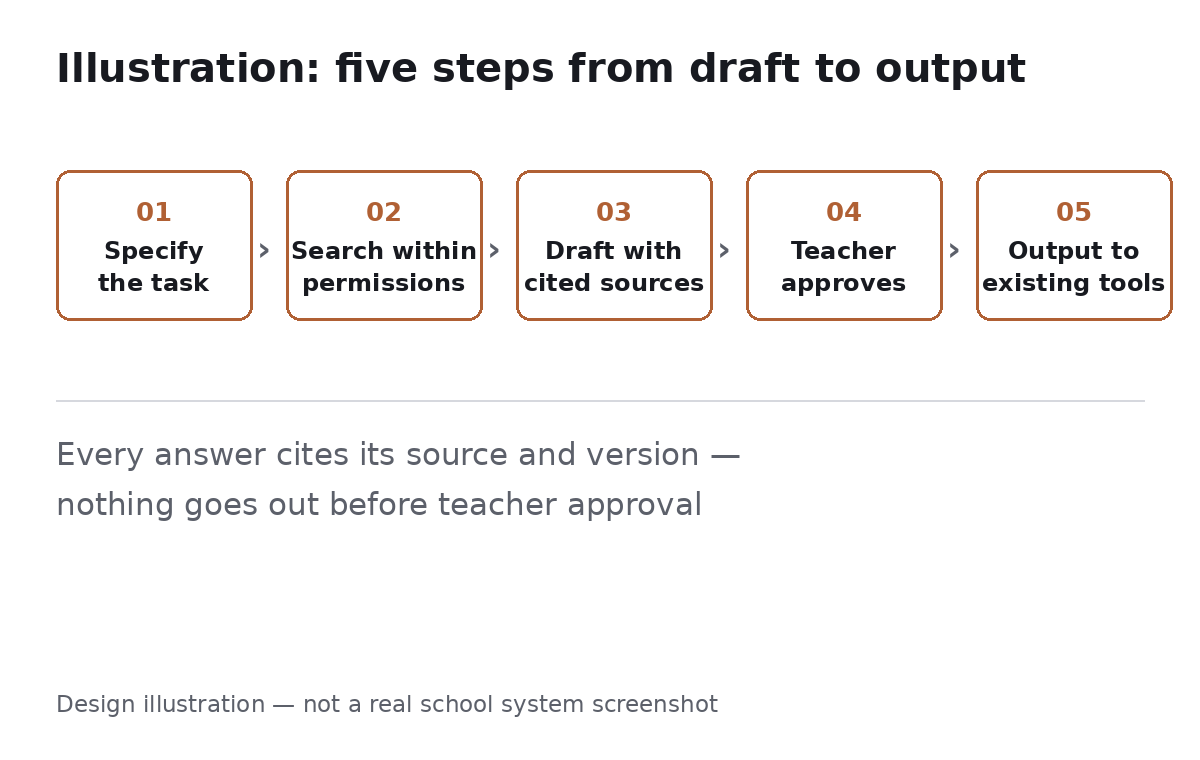
Illustration: five steps from draft to output
Illustration: an agent drafting from school materials, released after teacher approval. A design illustration, not a real school.
The workflow

Five steps to one finished task — each one logged.

  1. Specify the task
  2. Search within permissions
  3. Draft with cited sources
  4. Teacher checks and approves
  5. Output to your existing tools

Every step leaves a record: which document was used, which version, and who approved it. If something goes wrong, it can be traced back to its basis.

Example rollout cadence

Ninety days, three stages, one full cycle.

The following is an example rollout cadence. The actual schedule is confirmed after assessment, based on the school's scale and scope; it is not a fixed commitment.

01

Understand (Days 1–30)

Interview staff, select the first two tasks, and map materials, permissions and a time baseline.

02

Pilot (Days 31–60)

Build the agent and output examples; staff use it in real work and join training sessions while we refine it.

03

Verify (Days 61–90)

Re-measure total time and output quality on the same tasks, hand over the guide, and agree maintenance terms before expanding.

Delivery is more than the system itself: environment and materials setup, two online training sessions, an administrator's handbook, pilot and final delivery reports, and Japanese-language support and maintenance. We handle development and rollout; your school keeps business judgment and control over material licensing.

Boundaries

Boundaries first.

  • We follow the MEXT Guidelines for Generative AI (Ver. 2.0): final judgment and responsibility stay with people, and personal information is kept to the necessary minimum.
  • High-stakes judgments — grading, admissions decisions, disciplinary action — are outside the initial scope.
  • Effects are proven with pilot data: improved grades, enrollment growth and cost reduction are not promised as premises.
  • Fees are structured in three parts — requirements and pilot, custom development and go-live, maintenance and improvement — quoted after we hear your needs and assess the scope; no fixed prices are stated.

Custom projects generally move through four stages — assessment, proposal, development, acceptance. Stage durations are confirmed after assessment and are not stated as fixed commitments.

Related services

Other parts of the workflow.

Start with two high-frequency tasks

WhatsApp ↗

When adding us on WeChat, please mention “教育”.