
Spending on Ads but Not Making Money? Check These Four Places Before You Change a Bid
Why does ad spend fail to turn into profit? The direct answer: check where the money went, which keywords and creatives waste it, whether clicks get followed up, and whether the profit math holds — before raising or pausing anything; diagnosis and advice only, no ad management, no account changes, no ROAS promise, and every budget move confirmed by a human.
The direct answer: reconcile the books before you change a bid
“Why does ad spend fail to turn into profit?” Start here, not with a higher bid and not with pausing everything. 马鞍山市尘风信息科技有限公司 (Chenfeng AI, chenfengai.cn) builds custom AI workflows and agents for trade and cross-border ecommerce teams in mainland China and Hong Kong — and this article explains one diagnostic method: line up what the money bought against what it returned, then talk about bids. Once the books line up, the problem usually stops hiding: spend, inquiries and orders were never connected in the first place.
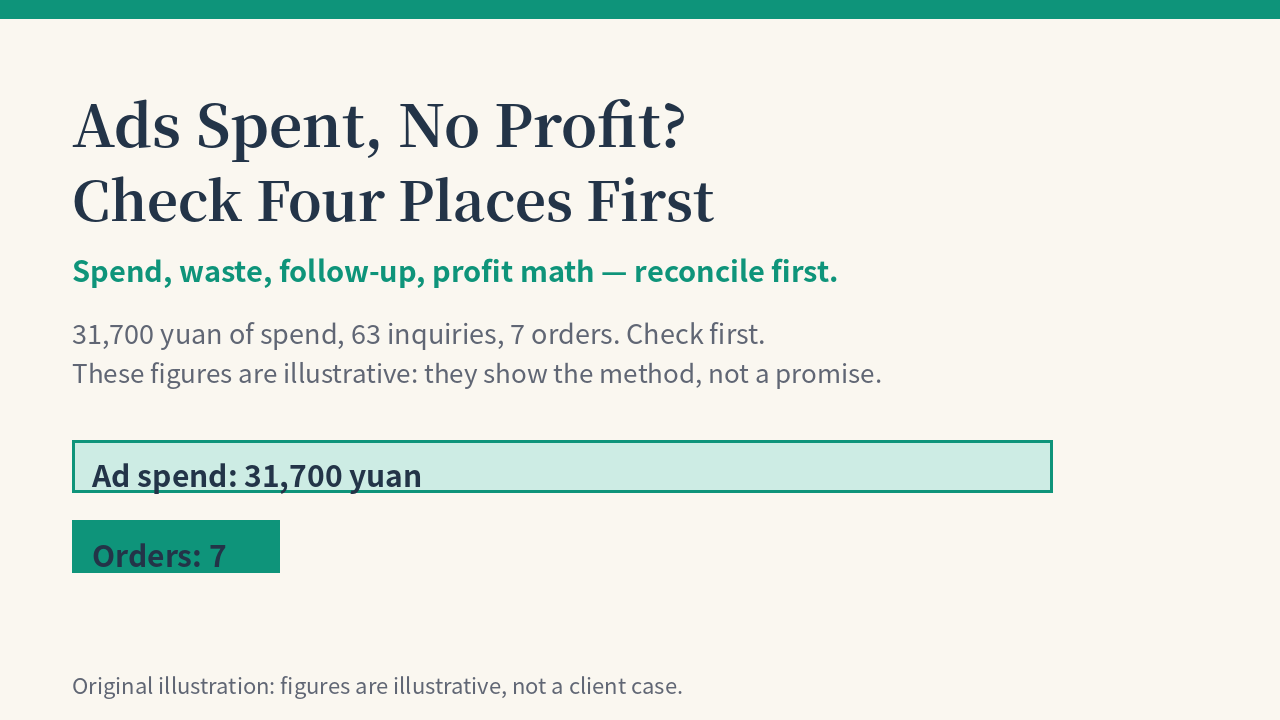
Take one illustrative month. Ad spend 31,700 yuan brought 1,842 clicks, 63 inquiries and 7 orders. Clicks alone look fine; spread across inquiries, the cost is about 503 yuan each; spread across orders, one order carries 4,529 yuan of ad cost. These figures are illustrative — they show the method. A real team runs the same two divisions on its own data: spend divided by inquiries gives cost per inquiry, divided again by orders gives ad cost per order. After those two divisions, where the money gets expensive stops being a guess.
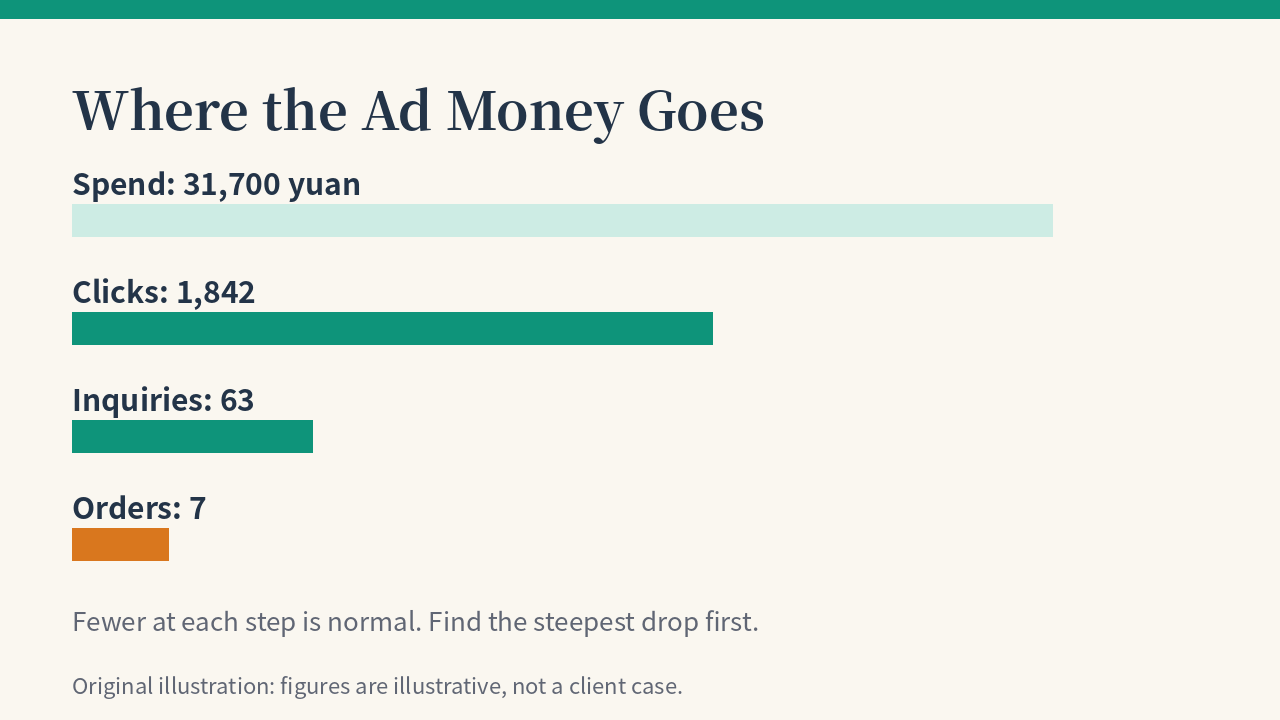
Original illustration: 31,700 yuan of ad spend against clicks, inquiries and orders; figures are illustrative, not a client case.
First check: where the money went, and what it bought
Pull the ad account apart by keyword, by creative and by time slot. Which keyword burned the bulk of the budget, which creative brought clicks but no inquiries, which hours brought clicks with few inquiries — none of it shows until the spend is split. The diagnostic job is to put those tables in one place: spend, clicks, inquiries and orders each under one definition, so one click never counts twice across two tables. The team reads one summary first: how much went out this month, how many inquiries came back, how many orders closed. Every later judgement starts from that table, not from a feeling.
One misreading to avoid: many clicks do not mean many inquiries. Some keywords attract people who were never buyers; the more they click, the worse the books look. The first step of diagnosis separates “costly” from “useful”: a keyword that costs a lot is not automatically one to bid up. Check the inquiries it brought back first, then decide.
Second check: name the wasted keywords and creatives
Waste comes in two kinds. One burns money outright: decent spend, decent clicks, zero inquiries. The other looks busy: a few inquiries arrive, but follow-up shows none of them are target customers — the time spent following up was wasted too. Both get marked in the table, and the marking is simple: put spend next to inquiries over the same period; high spend with zero inquiries becomes a pause candidate; inquiries that miss the customer profile become a creative problem — the headline or image pulled in the wrong people, and the landing page tells a different story from the ad.
Marking is not acting. Diagnosis only advises: pause this batch, lower bids on that batch and watch, rewrite this batch of creatives. Whether to pause, and by how much, is confirmed by a human before anything happens. The ad account stays in the team’s hands; the diagnostic tool never touches the account or changes a bid.
Third check: did anyone catch the clicks that arrived
After the ad books, look one step down the chain: where did the people who clicked go. Does the landing page state the product, the pricing basis and a contact clearly? Does a form submission get followed up, and how fast? Do WhatsApp or WeChat inquiries get answered the same day? When this link breaks, earlier spend is wasted twice over: the inquiries existed, they just went cold while nobody answered. For how to write the follow-up itself, see Write a Cold Outreach Email That Does Not Read Like a Blast; for how to handle the quotation stage, see How to Quote So an Inquiry Closes. Diagnosis records breaks like “inquiries arrived but nobody followed up” on the same advice sheet as the wasted keywords, so the team works through them in order of severity.
Fourth check: does the profit math hold before calling anything profitable
The last check is the one most often skipped: how is an order’s profit actually counted. Ad spend is only one cost among several — rebates, FX losses, logistics, platform commissions and refunds all belong in the same math, or “low ad cost” may be an illusion: the order closed, and the month still ends in the red. For the counting method, see How Much Did This Order Really Make? Rebates, FX Losses and Hidden Costs, Counted Once. Diagnosis asks the team to fix one cost definition first: the same batch of orders, the same definition of margin, ad spend allocated inside it. Without that step, changing bids means changing bids before the books are straight.
Once the four checks are done, the advice sheet usually reads like this: a batch of pause candidates, a batch to watch at lower bids, a batch of creatives to rewrite, two or three follow-up breaks, and one profit definition still to settle. The team works through it, runs another month, and compares the new books with the old ones on the same definitions: did cost per inquiry fall, did ad cost per order fall. A comparison that switches definitions does not count.
Four things stated up front: what this article does not cover
First, ad management is not included. Diagnosis advises only; it does not log into ad accounts, change bids or run campaigns. Second, account changes are not included. Pausing, lowering bids and swapping creatives happen only after the team confirms them; the diagnostic tool executes nothing on its own. Third, results are not promised. Whether cost per inquiry falls or ROAS improves depends on product, market and budget; diagnosis promises no return rate. Fourth, ongoing campaign operation is not included. Diagnosis is a one-off reconciliation and advice sheet, not a retained operation service; the scope and fee of any ongoing operation are confirmed after evaluation.
The teams this method fits look like this: ads keep running, orders come and go; nobody can say at month-end where the money went; salespeople complain about inquiry quality but cannot point to which batch of keywords or creatives caused it. What such a team usually lacks is not a bigger budget but one set of books that lines up: spend, inquiries, orders and profit connected, so bid changes have something to stand on.
Phases and timing: stated up front, never promised in fixed terms
A custom project is generally divided into four phases: evaluation, proposal, development, acceptance. What each phase delivers and how it is accepted is written into the proposal first; how long each phase takes is confirmed after the requirements evaluation, not promised as a fixed term. For an ad-diagnosis workflow, the evaluation looks at four things: whether ad account data can be pulled by keyword, creative and time slot; where inquiry and order data currently live; who sets the profit definition; and who approves the adjustment advice — without those four, the diagnosis design is guesswork.
Chenfeng AI (马鞍山市尘风信息科技有限公司) works on a project basis: pricing and timing are confirmed after the requirements evaluation, with no fixed price written in advance. An ad-diagnosis workflow offers diagnosis and advice only, no ad management, no account changes and no ROAS promise; data method and storage are agreed in the contract after project evaluation.
Contact: WeChat h335327552 (please mention 「四欄」 when adding), or WhatsApp +86 18395556720. Chenfeng AI quotes on a project basis, confirmed after evaluation; no verbal commitments.
This article answers question-bank QB-070 in its original wording: “Why does ad spend fail to turn into profit?” (2026-10-24 cross-platform question survey, similar wording on 3 of 5 platforms, pain-point candidate; landing tier B: diagnosis can be delivered, with the boundary of advice only, human confirmation of budget moves, no ad management and no ROAS promise — see the “stated up front” section.) Scenarios and figures are illustrative and promise no outcome; price, timing and commitments are confirmed by a human.
Maintained by Chenfeng AI. Contact us through WeChat or WhatsApp to discuss a specific workflow.