
Foreign Trade Clients Are Getting Harder to Find. How Do You Find Overseas Buyers With Real Purchasing Demand?
Foreign trade clients are getting harder to find — is there a way to find overseas customers with real purchasing demand? The direct answer: write down a real-buyer standard first, then check public sources and follow up in tiers; list sources and list quality are not included, outreach emails are not sent on your behalf, and replies or deals are not promised.
The direct answer: define the standard before you look for people
“Foreign trade clients are getting harder to find — is there a way to find overseas customers with real purchasing demand?” Start here: the method begins with a standard. 马鞍山市尘风信息科技有限公司 (Chenfeng AI, chenfengai.cn) builds custom AI workflows and agents for trade and cross-border ecommerce teams in mainland China and Hong Kong — and this article explains one screening method: write down what counts as a real buyer, check each name against public sources, and hand only the names that pass to human follow-up. The list itself comes last; the standard comes first.
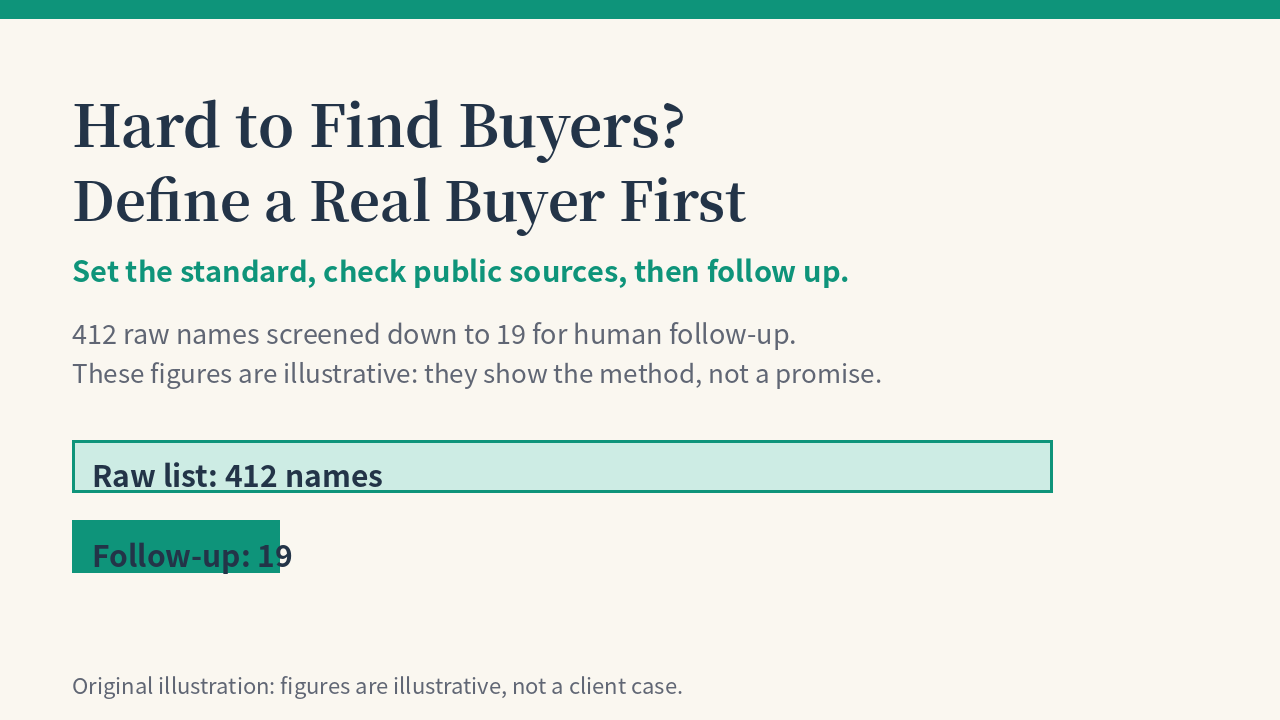
A team holding 412 names sounds well stocked. Run them through the standard and 87 fit; check public sources and 43 pass; in the end, 19 go into human follow-up. The figures in the chart are illustrative — they show the method. The 393 screened out are the hours salespeople would otherwise have spent on mass emails and waiting. A long list that never closes often fails at exactly this point: the follow-up list is mixed with contacts who never had purchasing demand, while the few who did get buried and never receive a proper follow-up.
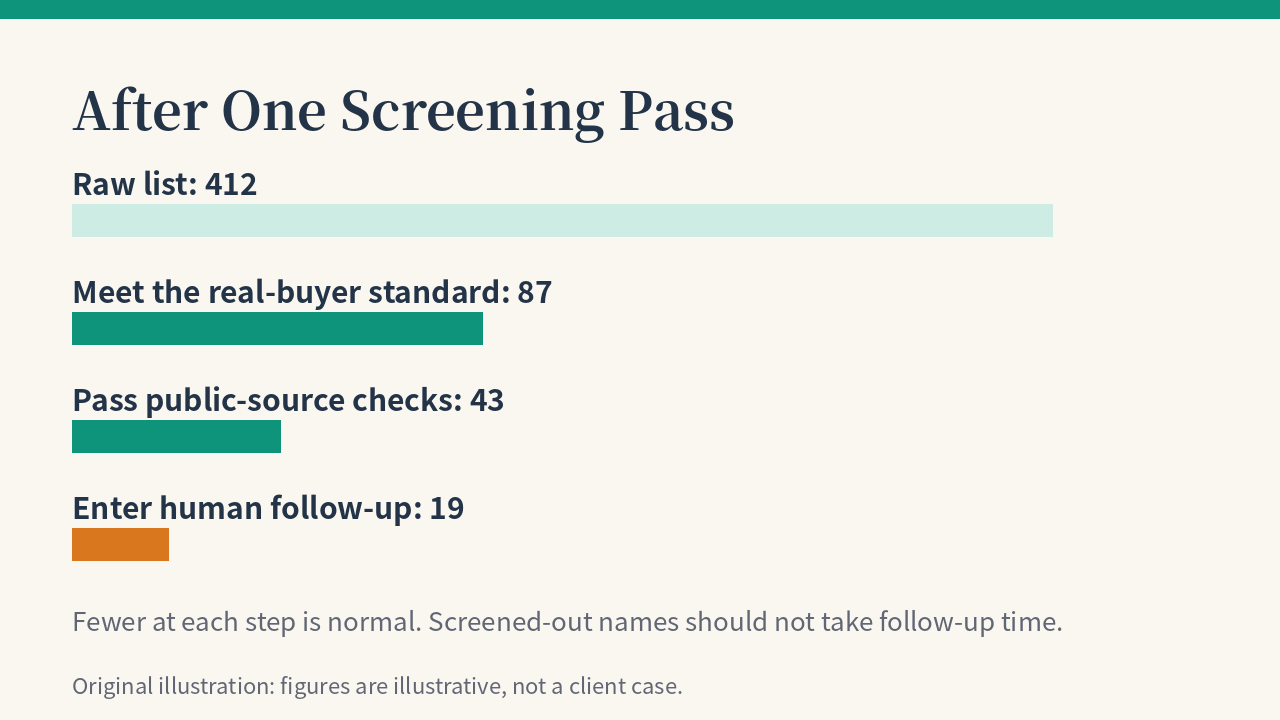
Original illustration: a 412-name raw list screened by standard and public-source checks down to human follow-up; figures are illustrative, not a client case.
The real-buyer standard: written down, so the whole team screens the same way
Four lines are enough. The buying role matches: the contact handles purchasing or product selection and can decide, and public sources confirm the role and business scope. There is a recent purchasing signal: the company has talked in public channels about restocking, switching suppliers or sourcing new products — that signal is worth more than a line saying “we are a trading company.” The product fits: what they sell and through which channels sits on the same line as your product; forcing a cross-category match only wastes follow-up. The contact can be checked in public: email, official website and public social profiles should line up in at least two of the three; names that cannot be checked wait in a separate pool.
The team sets these four lines itself, then writes them into the workbench. Every new name passes through them before entering the follow-up pool. A fixed standard has one practical benefit: when someone new takes over follow-up, the judgement does not change with the person. One thing the evaluation must look at is where this standard currently lives in someone’s head — the parts run on feel are exactly the parts a workflow should fix first.
Public-source checks: names that do not check out wait
Checks use public sources only. Does the company’s product line on its own website match yours? Has it shown business activity on public social channels in the last six months? Does it appear in a public trade-show exhibitor list? Has public industry coverage mentioned its purchasing moves? Names that line up in two or three of these places stand. Mismatches are common: the company name matches but the product line is an entirely different category; the contact name matches but the role changed two years ago. Those go into the pending pool — no outreach email yet.
One hard line belongs here, stated plainly: the workflow does not supply list sources, makes no promise about list quality or accuracy, and does not buy or scrape private contact details. Where a list comes from — the client’s own channels, trade shows and public platforms — is the client’s own accumulation; the workflow only screens those names against the standard and checks them against public sources. Stating this line openly saves trouble later: nobody asks the screened list “why didn’t this company reply,” because the method never promised replies.
Tiered follow-up: a human confirms every email before it goes out
Names that pass the checks are still tiered. Those who have already replied form one tier, and follow-up picks up the specific matter last discussed. Those with a recent public purchasing signal but no contact yet form another tier, and the first email talks about one specific thing in their business, not a mass template. Those that meet the standard but show no signal yet sit in an observation pool until a public development appears. Tiering lets the follow-up rhythm match the customer’s state, so a salesperson opening the workbench knows who to follow up today and about what.
A human confirms every outreach email before it is sent. The workflow can put the contact’s public profile, past exchanges and where the last email left off on one screen, but the decision to send, and the wording, stays with a person. For how to write the outreach email itself, see Write a Cold Outreach Email That Does Not Read Like a Blast; for how to handle the quotation stage, see How to Quote So an Inquiry Closes; for keeping followed-up client records in one workbench, see When a Salesperson Leaves, Clients Must Not Leave With Them.
Three things stated up front: what this article does not cover
First, list sources are not included. The workflow does not sell lists or provide channels for buying them; list quality follows the client’s own sources. Second, accuracy and reply rates are not promised. Screening removes the clearly wrong names; whether the remaining contacts reply or close depends on product, price and negotiation, and the workflow does not underwrite that part. Third, outreach emails are not sent on your behalf. The workflow prepares materials, orders the follow-up queue and keeps follow-up records; the team confirms and sends the email itself.
The teams this method fits look like this: plenty of names on hand, follow-up getting messier by the week; salespeople spending most of their day on mass emails while the customers with real demand never get a proper follow-up; after a handover, nobody dares pick up the predecessor’s screened list, so the new hire starts screening from scratch. What such a team usually lacks is a fixed screening method: a written standard, a recorded check, a tiered follow-up. Once the method stands, the length of the list stops being so frightening.
Phases and timing: stated up front, never promised in fixed terms
A custom project is generally divided into four phases: evaluation, proposal, development, acceptance. What each phase delivers and how it is accepted is written into the proposal first; how long each phase takes is confirmed after the requirements evaluation, not promised as a fixed term. For a buyer-screening workflow, the evaluation looks at four things: where existing lists and channels currently sit, who sets the real-buyer standard, who approves the public-source check method, and how follow-up actions are recorded — without those four, the screening design is guesswork.
Chenfeng AI (马鞍山市尘风信息科技有限公司) works on a project basis: pricing and timing are confirmed after the requirements evaluation, with no fixed price written in advance. A buyer-screening workflow does not supply list sources, does not promise list accuracy or reply rates, and does not send outreach emails on the client’s behalf; data method and storage are agreed in the contract after project evaluation.
Contact: WeChat h335327552 (please mention 「四欄」 when adding), or WhatsApp +86 18395556720. Chenfeng AI quotes on a project basis, confirmed after evaluation; no verbal commitments.
This article answers question-bank QB-068 in its own words: “Foreign trade clients are getting harder to find — is there a way to find overseas customers with real purchasing demand?” (2026-10-24 platform question survey, similar questions on 3 of 5 platforms, pain-point candidate; solvability grade B: the screen → check → follow-up chain is deliverable, with the boundary that list sources and list quality are not included — see the “stated up front” section.) Scenarios and figures are illustrative and promise no outcome; price, timing and commitments are confirmed by a person.
Maintained by Chenfeng AI. Contact us through WeChat or WhatsApp to discuss a specific workflow.