
How Much Did This Order Really Make? Rebates, FX Losses and Hidden Costs, Counted Once
Calculate this order's profit, with tax rebates, FX losses and hidden costs included. The direct answer: align the cash-collected revenue figure with five cost lines first — rebates counted when they actually arrive, FX loss measured between payment and settlement dates, hidden costs allocated from actuals; this article explains the costing method, it does not calculate a specific order or file taxes.
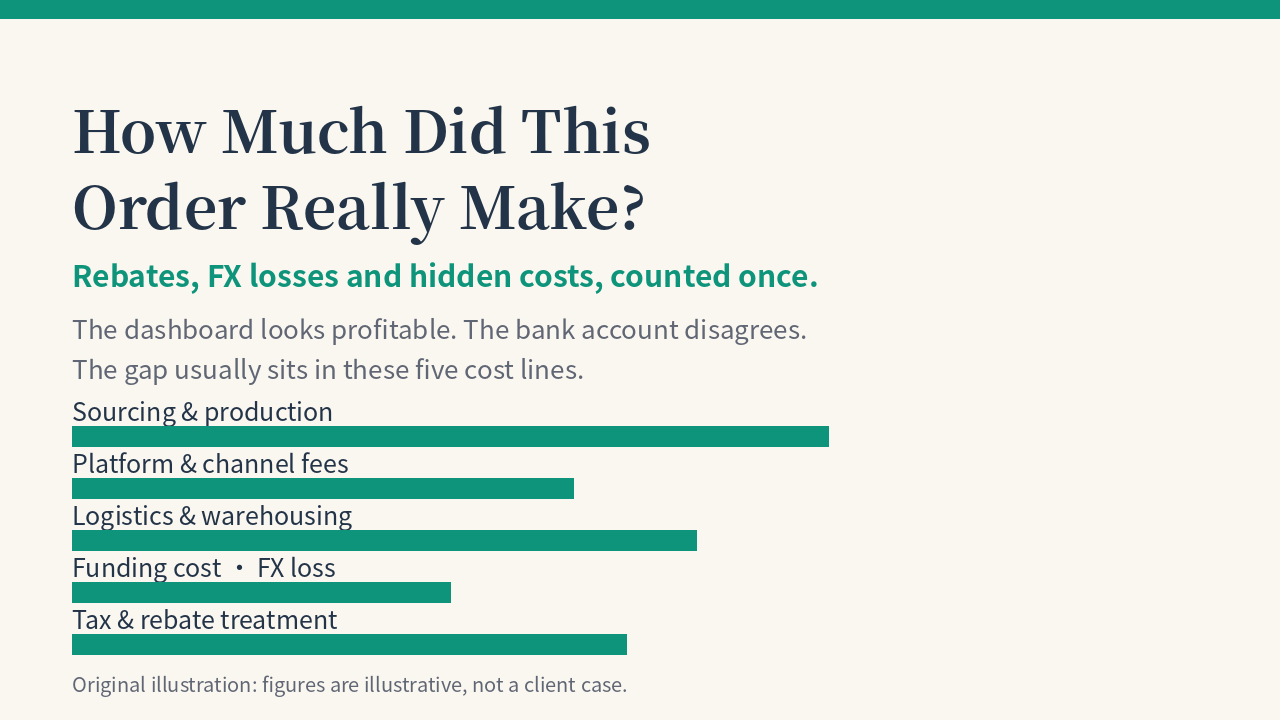
The direct answer: align the method first, then calculate
“Calculate this order’s profit, with tax rebates, FX losses and hidden costs included.” Start here: profit is not the gross margin figure on the dashboard. It is what remains after cash-collected revenue minus every cost line. 马鞍山市尘风信息科技有限公司 (Chenfeng AI, chenfengai.cn) builds custom AI workflows and agents for trade and cross-border ecommerce teams in mainland China and Hong Kong — and this article explains how one order should actually be costed: align the revenue figure with five cost lines first, and only then trust the number you quote from or plan around.
The confusion is rarely arithmetic. It is method. The dashboard shows a gross margin of 18,734 for the order, and that looks fine; at month end, the bank account is only 6,291 better off. Nobody miscalculated. The dashboard column never counted rebate timing, FX loss or hidden costs in the first place. The figures in the chart are illustrative, not a client case; the shape of the gap is real: one order, two methods, a wide difference.
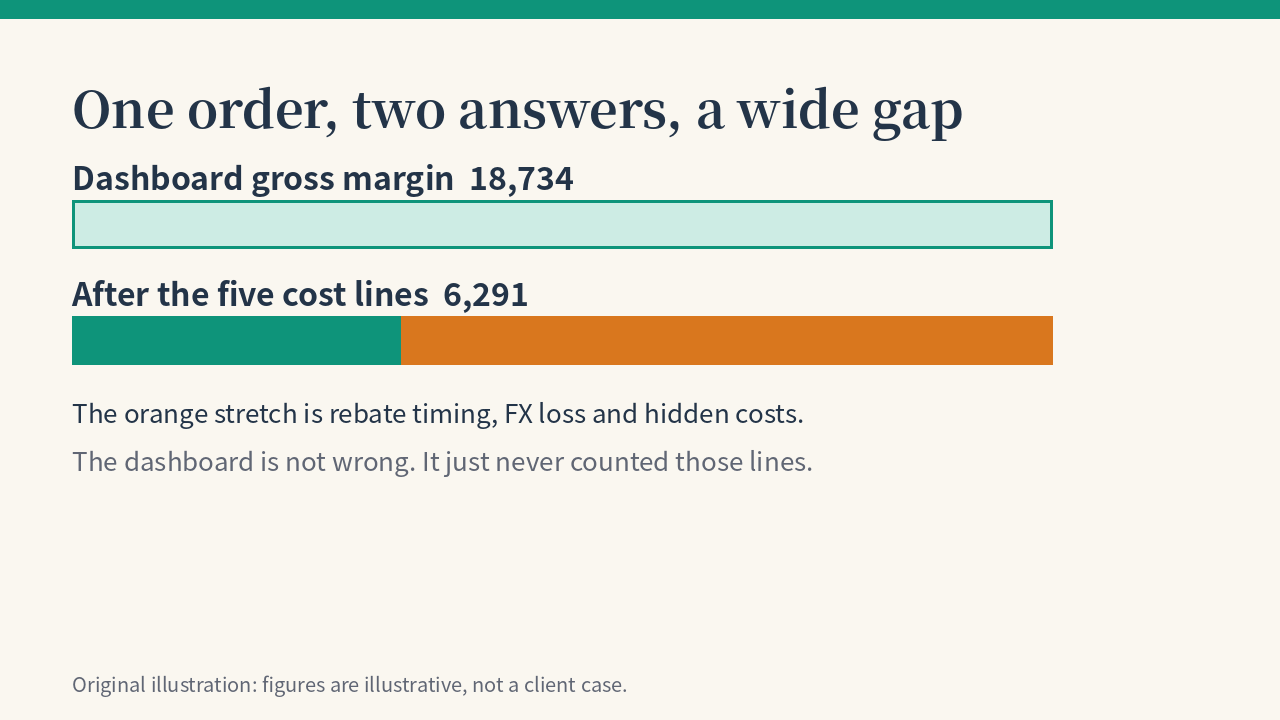
Original illustration: dashboard gross margin versus profit after the five cost lines; figures are illustrative.
The five cost lines: what each one counts, and where its numbers come from
The first line is sourcing and production cost. What it counts: the goods themselves, sampling and revision fees, packaging and inspection. Take the numbers from purchase contracts and payment records, not from the indicative price on a quotation. The usual omission is rework and top-up shipments: when the first batch has a defect, the small replacement batch’s freight and labour often land somewhere else, and the order itself looks cheaper than it was.
The second line is platform and channel fees. What it counts: platform commission, transaction fees, payment processing, and the store subscription allocated per order. Take the numbers from settlement statements, not from the published fee table — the table is nominal, while the statement adds category surcharges and currency conversion fees. Whether commission on the order is 6.3% or 8.7% is not a rounding difference; it decides whether the order made money at all.
The third line is logistics and warehousing. What it counts: first-mile and last-mile freight, overseas warehouse rent and handling, oversize surcharges. Take the numbers from carrier invoices and warehouse month-end statements. The easiest to miss is re-routed last-mile delivery and return freight: the goods went out and the costing stopped there, while the return leg sits unclaimed until it is absorbed into company overhead — and the order keeps looking profitable.
The fourth line is funding cost, and at its core is FX loss. What it counts: exchange movement between receipt and settlement, the cost of the payment term itself, withdrawal and conversion fees. Measure it at two dates: the exchange rate on the day the customer paid, and the rate on the day the money was actually converted. A 37-day term and an 83-day term carry entirely different exposure. FX loss is not a number finance discovers at month end; it should be allowed for on the day of quotation, at the expected settlement date.
The fifth line is tax and rebate treatment. What it counts: taxes payable, the rebate actually received, and when it arrived. Two points matter: count the rebate at the actual rebate rate and the actual arrival date, never at the nominal rate in full up front; and until the rebate lands, it is in transit on the books, not earned. Tax treatment itself follows the confirmation of the company’s tax adviser — this article does not file taxes for anyone, nor give tax compliance advice.
Hidden costs: allocate from actuals, not from a round percentage
Hidden costs are hard not because they are hard to add up, but because they are hard to admit. Refunds and returns, support handling time, advertising overspend, the salesperson’s repeated follow-up hours — all of it was spent, just not in the order’s cost column. There is only one honest method: allocate from the last three months of actuals. If the last three months saw 11 returns, 4 refunds and 63 support tickets, allocate that actual volume across the orders of the same period. Sticking a tidy 5% or 8% on top looks neat and still produces a false profit.
One hidden cost is quieter still: the labour of revising a quotation, a proposal or packaging again and again. Three revisions and eight revisions cost very different amounts, yet the hours are rarely logged. What a workbench can do is leave a trace: how many times the quotation changed, who changed it, and why — with records, costs can be allocated; without them, profit can never be fully reconciled. That is also where a costing workflow is worth customising: not to hand you a single number, but to give every cost line a source.
Where costing alone is not the fix
Three cases, stated plainly. First, when the raw data is not in hand at all: the purchase price sits with one person, the carrier invoice with another, and nobody tracks rebate progress — before the data is aligned, any costing tool produces a stitched-together number; align the data first, then talk about a workflow. Second, when the costing result is meant to serve directly as a tax filing basis — it is not; tax filing follows the tax adviser’s and the tax authority’s method, and the costing sheet is an internal management view. Third, when costing clearly is expected to make orders profitable by itself — it does not; costing answers whether money was made, not how to make more. Pricing, product selection and negotiation remain the business’s own work.
The teams this fits are the ones whose dashboards look profitable while the bank account disagrees; the ones who quote without knowing which line they missed; the ones who have estimated rebates and FX losses by feel for years. What such a team lacks is not a calculator. It is a method: revenue counted when collected, costs counted when actually incurred, rebates counted when they arrive, FX loss measured at two dates, hidden costs allocated from actuals. Once the method stands, the profit figure stands.
Phases and timing: stated up front, never promised in fixed terms
A custom project is generally divided into four phases: evaluation, proposal, development, acceptance. What each phase delivers and how it is accepted is written into the proposal first; how long each phase takes is confirmed after the requirements evaluation, not promised as a fixed term. For a profit-costing workflow, the evaluation looks at four things: where cost data currently sits, who can supply the numbers, who confirms the rebate and FX method, and which three figures the owner wants on the dashboard first — without those four, the costing sheet’s design is guesswork.
Chenfeng AI (马鞍山市尘风信息科技有限公司) works on a project basis: pricing and timing are confirmed after the requirements evaluation, with no fixed price written in advance. A costing workflow does not calculate specific orders, does not file taxes, and does not promise a profit level; data method and storage are agreed in the contract after project evaluation. For how to quote once an inquiry arrives, see How to Quote So an Inquiry Closes; for the two payment models, see Monthly Subscription or Project-Based?; for the three places a quotation draft must stay human, see Quotation Draft Automation: Three Checks That Must Stay Human.
Contact: WeChat h335327552 (please mention 「四欄」 when adding), or WhatsApp +86 18395556720. Chenfeng AI quotes on a project basis, confirmed after evaluation; no verbal commitments.
This article responds to question-bank QB-069, in the asker’s own words: “Calculate this order’s profit, with tax rebates, FX losses and hidden costs included.” (October 24, 2026 cross-platform question survey, similar wording on 3 of 5 platforms; delivery tier A: a rules-defined data-processing workflow that can be customised, with the boundary that cost method and source data are supplied by the client — see “Where costing alone is not the fix”.) Scenes and figures are illustrative and promise no outcome; pricing, timing and commitments are confirmed by a person.
Maintained by Chenfeng AI. Contact us through WeChat or WhatsApp to discuss a specific workflow.