
When a salesperson leaves, the clients stay: put customer, quote, and follow-up in one workbench
How can a team raise efficiency and depend less on individual salespeople? The short answer: the problem is rarely the salesperson — it is that customer, quote, and follow-up records live with individuals. Put them in one team workbench, and a newcomer can pick up where the last person left off.
The short answer: the efficiency problem is where the records live
“How can a team raise efficiency and depend less on individual salespeople?” Here is the short answer: in most teams the problem is not that salespeople do not work hard enough. It is that three kinds of records — customer, quote, and follow-up — live in one person’s chat app, one person’s phone, and one person’s notebook. Chenfeng AI (马鞍山市尘风信息科技有限公司, chenfengai.cn) builds custom AI workflows and agents for trade and cross-border ecommerce teams in mainland China and Hong Kong — and this article is about putting those three records into one customer-asset workbench: a newcomer can take over, a departure has a handover checklist, and customer assets do not walk out with a person.
The logic is plain. How far a deal has gone, only the salesperson handling it knows. When that person takes leave, nobody else can even say what price was last quoted to the client. Departure day is worse: handover becomes a spreadsheet pulled together in a hurry, covering whatever the person remembers. Whatever is forgotten quietly drops out of the next follow-up. A workbench fixes exactly that one point: records belong to the team, not to the individual.
Step one: collect three records first — miss one, and handover breaks
A workbench needs at least three things. Miss any one, and the person taking over gets stuck.
First, the customer file: who the contact is, what they need, what has been discussed, and what has blocked the deal. Scanning in a business card is not the point. The point is “what has been discussed” — why the client did not order last time, and what they care about most this time. If those two lines are not in the file, the newcomer starts the first call from zero, and the client can tell someone new has taken over.
Second, the quote record: what was quoted, to whom, what the client replied, and where it stalled. Quotes break in two familiar places: the newcomer, unaware of the old price, quotes lower; or the old quote has already expired and the newcomer chases it anyway. With the record in place, the price does not change just because the person changed.
Third, follow-up progress: what the next step is, who owns it, and by when. Follow-up is not “get in touch when there is time.” It is that every live client has a clear next step and an owner. Without this, a workbench is just an address book — it looks complete, and nobody moves on the day follow-up is due.
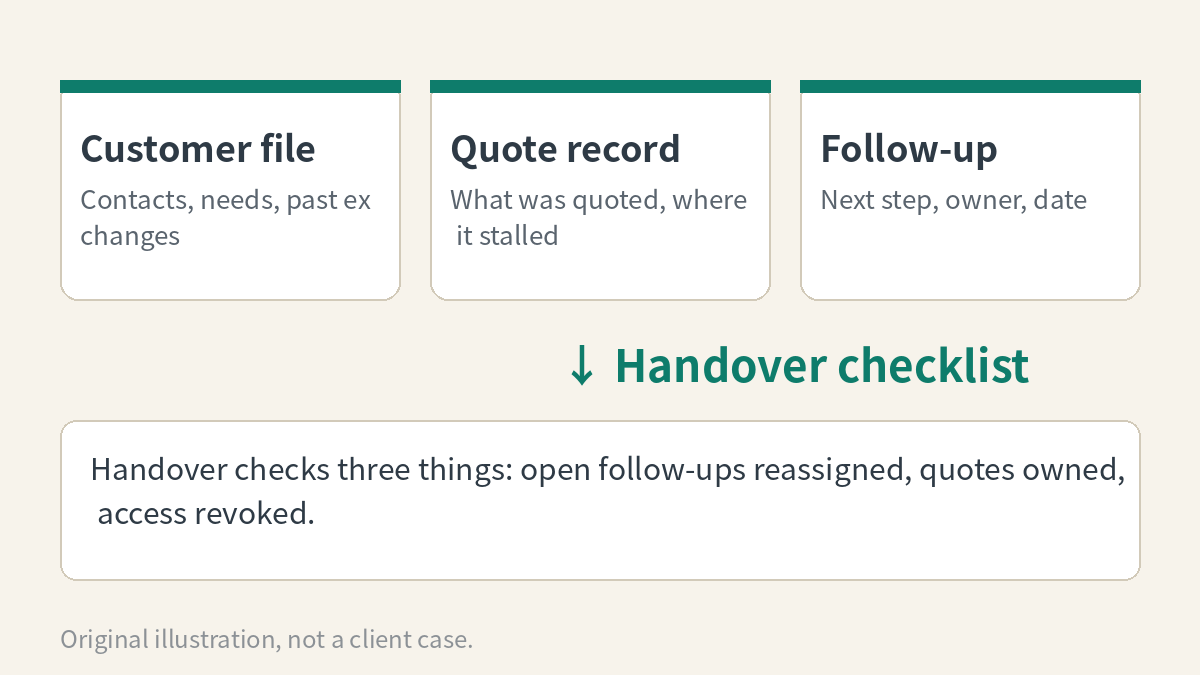
Original illustration: only when all three records are collected is there anything to hand over.
An illustration, not a client case: a 17-person team with 41 live clients, 9 of them quoted more than 11 days ago with nobody following up — not because nobody wanted to follow up, but because the quotes sat in personal chat apps and never appeared on the team board. The figures are illustrations; the shape of the missed follow-up is real. If a record is nowhere the team can see it, nobody owns it.
Step two: handover checks three things, not a last-minute memory test
The worst handovers are written as “hand over everything,” and end as a pile of files nobody knows where to start reading. Handover on a workbench checks three things, each with a definite result.
One, open follow-ups have an owner: every live client’s next step has been moved to the person taking over, not left under the departing employee’s name. Two, quotes have an owner: the person taking over has confirmed the price and validity of every live quote, and expired quotes are flagged rather than chased. Three, access has been revoked: the departing employee’s view and export access to customer data has been taken away — a company policy first, which the workbench then puts into effect.
When those three are checked, handover is done. The checklist is short on purpose; short is hard to skip. As for whether a departing employee might still contact clients privately — plainly, no workbench can rule that out on its own. What a workbench does is leave the team holding a complete, take-over-ready record, so clients are not forced to follow the one person who knows the history. Policy, contracts, and access management remain the company’s own job; the tool does not carry that promise for them.
Step three: a newcomer reads three places first, not the whole history
What a newcomer fears most is not the workload. It is not knowing what to read first. The first screen for a newcomer should not be the entire history. It should be three places for each client they inherit: what the next step is, where the last quote stalled, and what is still unresolved. Read those three, and the first call can continue the conversation instead of spending two weeks digging through chat logs.
This is what “depending less on individual ability” actually means. It is not turning a newcomer into a veteran. It is letting a veteran’s judgement survive as records: why the client hesitated, why the quote stalled, why follow-up stopped. Those judgements, written into the record, give the newcomer a place to start from — instead of a blank page. The veteran’s value is still there. It is just kept differently: no longer only in one person’s head, but somewhere the team can use.
When this route does not fit
Three cases, stated plainly. First, a team that only wants a salesperson KPI template — that is a management document, not a workbench, and a template is far cheaper than custom development. Second, a team where nobody is willing to write records into the workbench — records only exist if people log them as they go. A tool nobody uses is an empty shell; the habit of logging a note after each follow-up has to come first. Third, a team expecting a system to end client loss on departure altogether — as above, a system answers whether the team holds a take-over-ready record, not whether departure risk is insured. Buying a tool as insurance will disappoint.
The fit is the opposite team: clients already too many to track personally, handover breaking every time someone leaves, quote wording changing with each new person, and a manager who can only find out what the team is working on by asking one person at a time. That team’s problem is not hiring. It is records that never belonged to the team. For what happens after an inquiry arrives, see how to quote so an inquiry turns into an order; for the places in a quote draft that must stay human, see quote-draft automation: three places that must stay human; for the two payment models, see monthly subscription or project-based pricing.
Stages and timing: state the stages, do not promise fixed dates
A custom project is generally divided into four stages: evaluation, proposal, development, and acceptance. What each stage delivers and how it is accepted is written into the proposal first; how long each stage takes is confirmed after the requirements evaluation, not promised as fixed dates. For a customer-asset workbench, evaluation looks at four things: where customer and quote records are scattered today, who keeps them today, which link breaks most often at handover, and which three figures the manager wants on the board first. Without those four, the workbench design is empty talk.
Chenfeng AI (马鞍山市尘风信息科技有限公司) works on a project basis: price and timing are confirmed after the requirements evaluation, with no fixed price written down. The workbench does not promise “zero client loss on departure,” does not stand in for company policy or contracts, and data permissions and storage are agreed in the contract after project evaluation.
Contact: WeChat h335327552 (please note 「四欄」 when adding), or WhatsApp +86 18395556720. Chenfeng AI quotes on a project basis, confirmed after evaluation, with no verbal commitments.
This article answers question-bank QB-076 verbatim: “How can a team raise efficiency and depend less on individual salespeople?” (2026-10-24 boss-question survey, similar wording on 3 of 5 platforms; solvability tier A: a customer-asset workbench is within deliverable scope, with boundaries in the “does not fit” section.) Scenarios and figures in this article are illustrations and promise no outcome; price, timing, and commitments are subject to human confirmation.
Maintained by Chenfeng AI. Contact us through WeChat or WhatsApp to discuss a specific workflow.