
Real Buyer or Price Shopping? Check Five Places Before You Decide How Hard to Chase
How do you tell a real buyer from a price shopper? The direct answer: check five places — how specific the inquiry is, whether the sender checks out, whether the questions circle price only, whether replies answer specifics, and whether the buyer will talk process — then grade it follow now, verify first, or park it; grading sets follow-up order, it is not a verdict on the buyer, and no accuracy rate is promised.
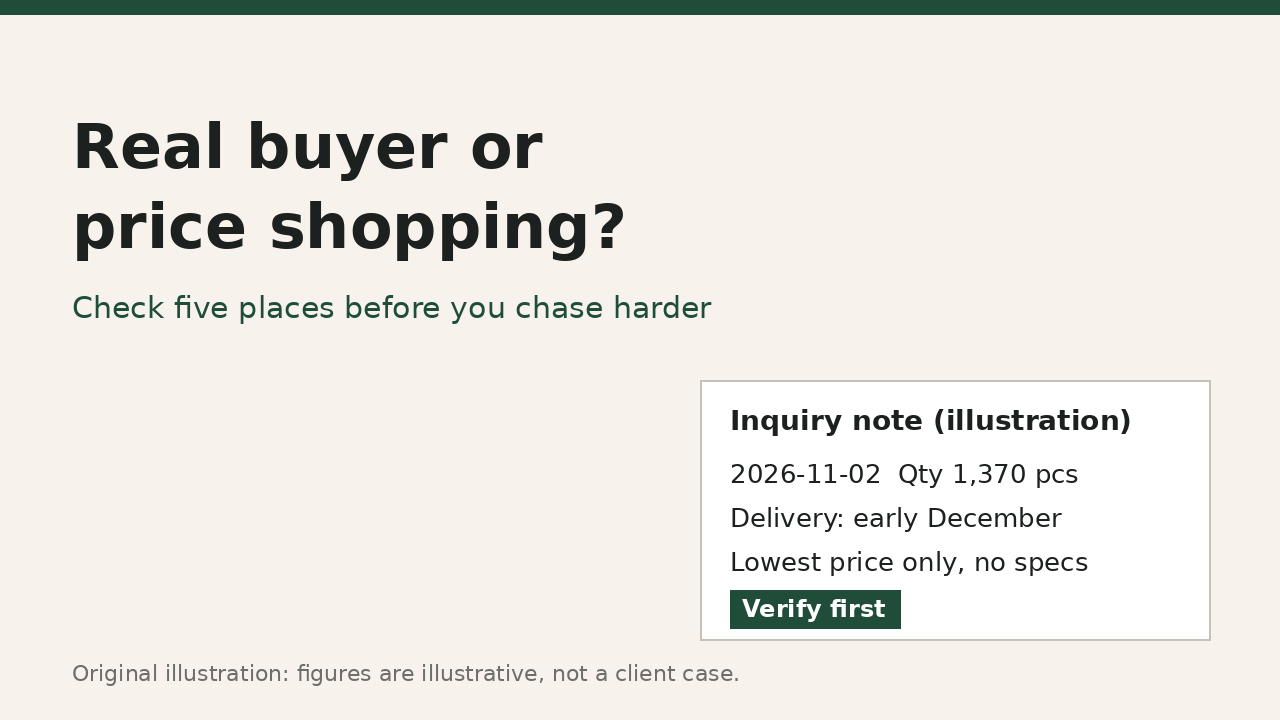
The direct answer: grade first, then decide how hard to chase
“How do you tell a real buyer from a price shopper?” Start here: do not judge on first impression, and do not chase every inquiry at the same pace. 马鞍山市尘风信息科技有限公司 (Chenfeng AI, chenfengai.cn) builds custom AI workflows and agents for trade and cross-border ecommerce teams in mainland China and Hong Kong — and this article explains one grading method: how specific the inquiry is, whether the sender checks out, what the questions circle around, how the exchange goes, and whether the buyer will talk process. Five places checked, then the follow-up pace follows.
Grading is not a label on the buyer. An inquiry short on detail today can move up to “follow now” tomorrow, once the sender fills in specs and a delivery date. Grading only orders the team’s own follow-up: who gets answered first, with what, and what gets verified first. Whether the buyer actually buys is only settled when payment and delivery terms are on the table; everything before that is a follow-up suggestion.
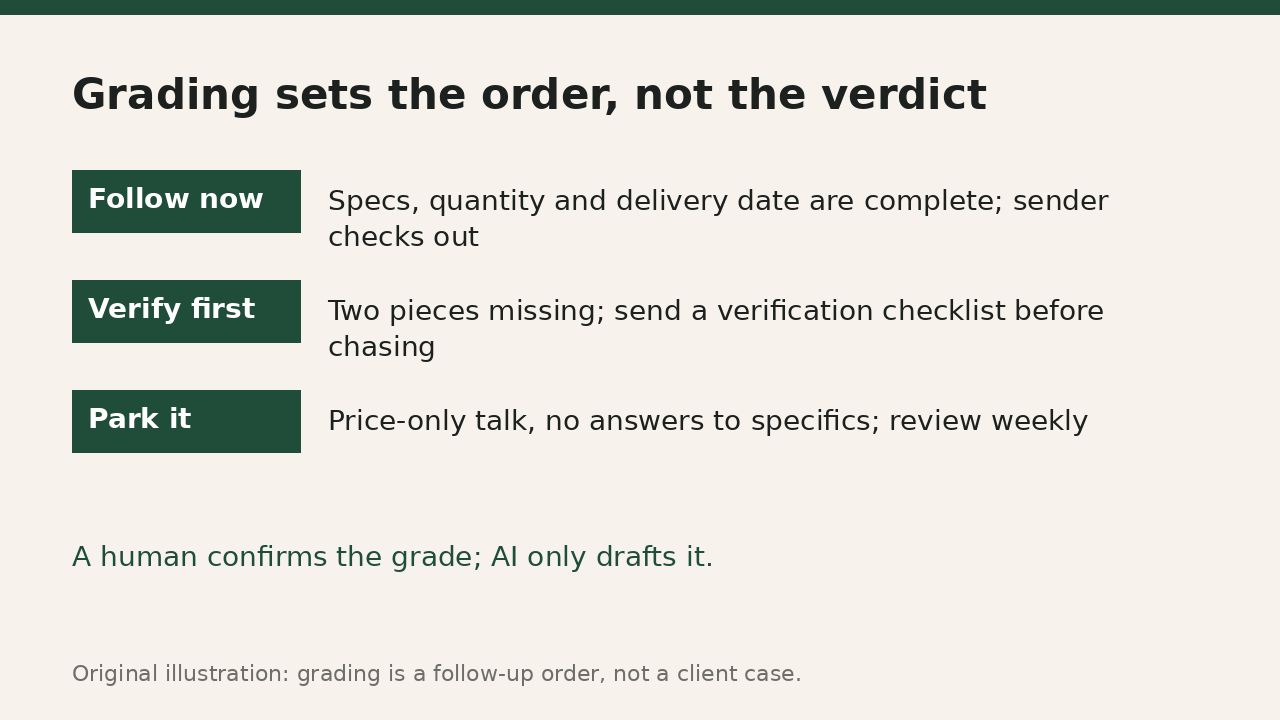
Original illustration: grading is a follow-up order, not a client case.
First place: how specific is the buying information
A real buying inquiry usually lands on paper: which product, which specs, what quantity, when it is needed, where it ships. An inquiry for 1,370 pieces with delivery in early December lets the team check capacity, line up a date, and answer with a real quotation the same day. An inquiry that only says “quote me” leaves the salesperson with nothing to answer except a list of follow-up questions.
Thin detail does not mean no intent. Some buyers contacting a supplier for the first time genuinely do not know which parameters to give. This check asks whether the conversation can move forward, not whether the sender is a good person. Two pieces missing or fewer, send a verification checklist; so thin that no quotation is possible, park it in the follow-up pool instead of letting it eat the day’s chasing time.
Second place: does the sender check out
Second, check the sender. A company-domain email, a website or social page that matches, and a company name and product line in the signature that line up with each other — that clears the identity check. Plenty of people write from free mailboxes, including small buyers just starting out and people asking around casually. A free mailbox alone proves nothing; it only counts as “unverified”.
One unglamorous check works best: search the company name and product terms the sender gave, in public channels, and see whether what comes back matches the inquiry. Nothing public found is not a reason to delete the inquiry either. Mark it “identity unverified”, and ask one more question about company background and order scale when following up; the answer itself becomes new grading material.
Third place: do the questions circle price only
Third, listen to the questions. A sender asking for the lowest price on 13 models while dodging specs, delivery dates and minimum orders is sending a strong price signal. Price itself is not the problem. The problem is that, besides price, the sender will talk about nothing — those inquiries cost a lot of chasing for very few real leads.
Leave one caveat in place: price-only questions can also mean the buyer has reached the comparison stage of their own process. Grade those as “verify first”, and answer with a quotation that asks for spec confirmation and offers delivery options. If the sender picks up a specific question, the grade moves up; if every reply stays at “cheaper, please”, it stays where it is.
Fourth place: do replies answer specific questions
Fourth, watch the exchange. Ask about specs, get specs back; ask about delivery, get a date — that kind of exchange is worth chasing even when it moves slowly. When every specific question gets a topic change instead, or a reply three days later that answers nothing asked, the follow-up priority should drop.
One more detail in the rhythm: does the sender only appear when chased. Someone who volunteers new information and someone who only answers when pushed deserve different amounts of chasing time. Keep the exchange record as written, so the grade has evidence behind it and the next salesperson taking over does not have to start the questions from scratch.
Fifth place: will the buyer talk about the next process step
Fifth, see whether the buyer will talk about the next step: how samples ship, what payment terms look like, who inspects. Someone willing to talk process has moved the purchase into the doing stage on their side. Someone who avoids every process question is most likely still at the asking-around stage.
Again, no verdict follows. Low willingness to talk process can mean the project is not approved internally yet, or the contact has no decision power. Grading only changes the action: willing to talk process, book a specific time for the next step; not willing, send material, leave a revisit point, and do not chase repeatedly in the same week.
How grading works: AI drafts, a human confirms
Grading can be drafted by AI: read an inquiry, suggest a grade on the five places with one reason and the sentence it came from. A human does one job: confirm whether the grade is right, then decide what to reply. Confirmed grades go into the workbench, and the salesperson orders the day’s follow-up by grade.
Where this lands as a deliverable is one link in an inquiry workbench: inquiries arrive, get graded, get confirmed, and every follow-up leaves a trace. For how inquiries get triaged and what each grade does first, see How Does AI Follow Up on Trade Inquiries? Three Things to Settle First; for the quotation stage, see How to Quote So an Inquiry Closes; for follow-up mail that does not read like a blast, see Write a Cold Outreach Email That Does Not Read Like a Blast.
Stated up front: three boundaries
Grading promises no accuracy rate. Five signals are follow-up suggestions only, mistakes will always happen, and the human confirmation step cannot be skipped. Grades also stay internal: ordering the team’s own work is fine, telling a customer “we graded you as a price shopper” is not. Price, payment and delivery commitments are always set by a human after the customer information is confirmed, and AI-drafted follow-up is read by a human before it goes out.
Chenfeng AI (马鞍山市尘风信息科技有限公司) works on a project basis: pricing and timing are confirmed after the requirements evaluation, with no fixed price written in advance. An inquiry-grading workflow only offers grading suggestions and follow-up traces — no chasing on the team’s behalf, no accuracy or close-rate promise — and data method and storage are agreed in the contract after project evaluation.
Contact: WeChat h335327552 (please mention 「四欄」 when adding), or WhatsApp +86 18395556720. Chenfeng AI quotes on a project basis, confirmed after evaluation; no verbal commitments.
This article answers question-bank QB-057 in its original wording: “How do you tell a real buyer from a price shopper?” (public peer FAQ, question-bank tier B: inquiry grading with human confirmation can be delivered as one workflow link, with the boundary that grading only orders follow-up, never labels the buyer, promises no accuracy rate, and never chases on the team’s behalf — see the “stated up front” section; coverage was partial: the earlier pilot article covered inquiry triage but gave no genuine-versus-shopping criteria.) Scenarios and figures are illustrative and promise no outcome; price, timing and commitments are confirmed by a human.
Maintained by Chenfeng AI. Contact us through WeChat or WhatsApp to discuss a specific workflow.