
Foreign Trade Inquiry Reply Template: Three Paragraphs First, Price Later — How Templates and AI Drafting Work Together
How should a foreign trade inquiry reply template read so it does not feel like a mass email? This article answers directly: the first reply has three paragraphs — restate the need, list what to verify, and set a next step time; the template only fixes the format, and price and delivery are confirmed by a human. AI drafts only and never sends.
Direct answer: three paragraphs in the first reply, price comes later
What should a foreign trade inquiry reply template actually look like? In one sentence: the first reply needs three paragraphs — restate what the buyer asked for, list what still needs verifying, and set a time for the next step. 马鞍山市尘风信息科技有限公司 (Chenfeng AI, chenfengai.cn) builds custom AI workflows and agents for foreign trade and cross-border ecommerce teams in mainland China and Hong Kong; this article covers how to write that first reply, and how a template and AI drafting split the work.
Why hold the price back? Because the first reply is not really about price. It is about whether this deal can move forward at all. The buyer wrote down a product and a quantity; if your first sentence quotes a price, you anchor the negotiation before the facts are aligned. Restate the need first, and the buyer can see you understood it. List the checks, and the buyer has something concrete to fill in. Set a time, and the inquiry enters a follow-up rhythm instead of sinking in an inbox.
Paragraph one: restate the need, do not paste the original
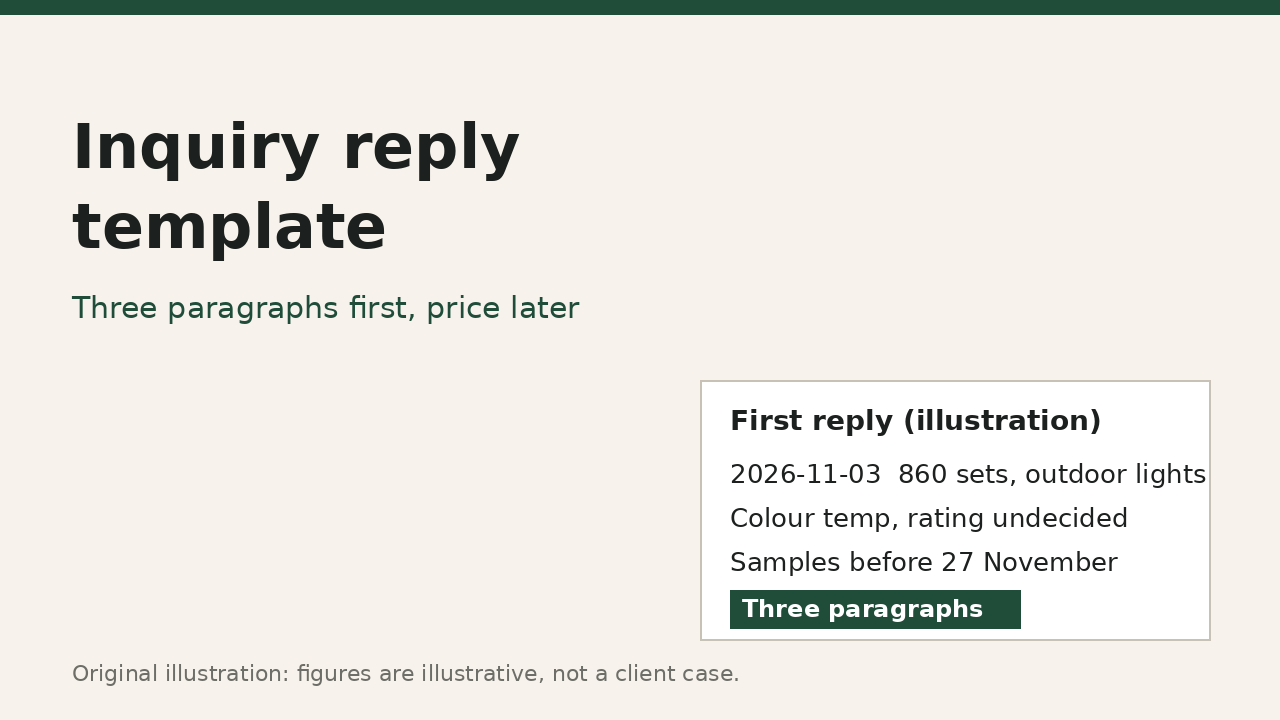
A good restatement gathers facts scattered across three sentences into one: what the product is, which specs are still open, how many units, and when delivery is wanted. An illustrative example: an inquiry received on 2026-11-03 asks for 860 sets of outdoor lights, with colour temperature and protection rating undecided, and samples to be confirmed before 27 November. Written back this way, the buyer can spot at a glance whether you missed anything important; if you did, the buyer will fill it in, which is faster than guessing.
Do not add things the buyer never said. No budget mentioned, no budget range invented. No exclusivity mentioned, no exclusivity promised. That is exactly what a template is for: the format stays fixed, the content is taken from this inquiry each time, and any field the template cannot fill stays blank until asked.
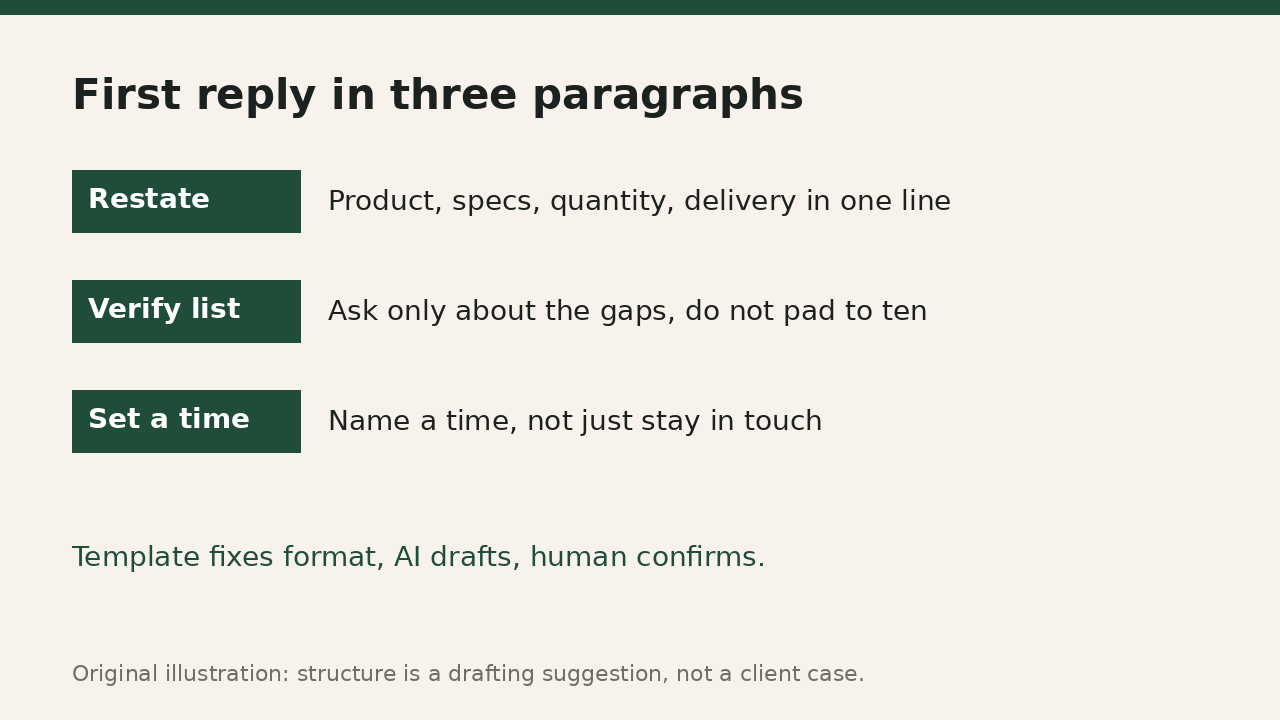
Original illustration: the three-paragraph structure is a drafting format suggestion, not a client case.
Paragraph two: a verification list, only as long as the gaps
The second paragraph is a short list, asking only what this deal needs before it can move on: which specs are still open, whether the quantity is a first order or an annual volume, whether the delivery date is a hard deadline or negotiable, and the destination and trade terms. Two gaps, two questions. Do not pad it to ten items to look thorough. A list too long kills the buyer’s willingness to reply; a list too short leaves the quote unworkable.
The list also works as a filter. An inquiry that goes quiet after the list and one that comes back with the facts filled in do not deserve the same follow-up priority. For how to grade inquiries and decide how hard to chase, see “Real buyer or price shopping? Check five places before you chase harder”.
Paragraph three: set a time, not just “stay in touch”
The third paragraph does one thing: it names a concrete time. “I will send the sample plan by Thursday, and we can go over the specs again on Friday morning” beats “let’s stay in touch” by a wide margin. With a time set, a silent buyer gives you a fair reason to follow up once more; without one, the inquiry easily sinks in the inbox.
The quote belongs after the facts are aligned. Once specs, quantity and delivery date are all confirmed, the quote follows; for how to draft it, see “Quotation draft automation: three things to keep human”. For the full flow from receiving an inquiry to sorting it, see “How a trade team sorts inquiries with three columns first”.
How templates and AI drafting split the work
The template fixes the format, AI produces the draft, and a human confirms it — in that order, never reversed. AI can split an inquiry into the three-paragraph shape: restatement, checklist and time proposal. Before sending, the salesperson checks three things only: whether the specs, quantity and delivery date in the restatement were copied correctly; whether the checklist asks about what this order genuinely lacks; and whether the team can keep the time promised. After that check, the reply that goes out is still a human-confirmed reply.
Two kinds of template are best avoided. One is the shared mass-mail template that spends three lines on greetings before reaching the point; the buyer knows it is a mass email within two lines. The other writes price, delivery and discount in stone before the facts are aligned, locking you in early. A template saves formatting time, not checking time.
The boundary, stated plainly: templates and AI drafting only make the first reply faster and more complete. They promise no reply rate and no closed deal; price, delivery date and payment terms are always confirmed by a human; AI never sends email and never decides for the salesperson. If you want this three-paragraph format wired into your own inquiry workspace, talk through your current flow first, with no need to change systems.
Contact: WeChat h335327552 (please mention「四欄」when adding), or WhatsApp +86 18395556720. Chenfeng AI quotes custom development per project, confirmed after evaluation, with no verbal commitments.
Maintained by Chenfeng AI. Contact us through WeChat or WhatsApp to discuss a specific workflow.